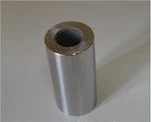


In a diesel engine, the function of the crank connecting rod mechanism is to convert the reciprocating linear motion of the piston into the rotational motion of the crankshaft, so as to realize the mutual conversion of thermal energy and mechanical energy.
The structure and working principle of the crankshaft connecting rod mechanism: the piston can only reciprocate along the cylinder block in a straight line. The crankshaft is composed of various journals whose center lines are not in a straight line, among which the main journals placed in the center hole of the body are called main journals. The main journal can only rotate around its own centerline in the body seat hole. The common centerline of each main journal is also called the crankshaft centerline. The other journal, called the crank pin, is connected to the main journal by the crank arm. It rotates around the main journal. The connecting rod is a straight rod with holes at both ends, one end is connected with the crank pin, the other end is connected with the piston pin, and it swings as the piston moves.
When the piston reciprocates, the connecting rod pushes the crankshaft to rotate around the centerline of the crankshaft.
Piston movement and crankshaft rotation are interrelated, so the position of piston movement corresponds to the position of crankshaft rotation.
The position at which the top surface of the piston is at the maximum distance from the centerline of the crankshaft is called the top dead center. The position at which the top surface of the piston is at the minimum distance from the centerline of the crankshaft is called the bottom dead center. The distance between the top and bottom dead centers of the piston is called the piston stroke. The piston moves one stroke for every half-turn (ie 180°) of the crankshaft.
When the crankshaft rotates at a constant speed, the speed of the reciprocating linear motion of the piston is constantly changing. When the piston moves to the top and bottom dead centers, the speed is equal to zero, and the speed is the highest at a certain position in the middle. During the reciprocating motion of the piston in the cylinder, the volume of space in the cylinder changes continuously. When the piston is at top dead center, the space above the top of the piston is called the combustion chamber. This volume of space is called the combustion chamber volume. The cylinder volume between the top and bottom dead centers is called the cylinder working volume. When the piston is at the bottom dead center position, the volume in the cylinder is called the total cylinder volume, which is equal to the sum of the combustion chamber volume and the cylinder working volume. The ratio of the total cylinder volume to the combustion chamber volume is called the compression ratio. The compression ratio expresses the degree to which the gas is compressed in the cylinder as the piston moves from bottom dead center to top dead center. The larger the compression ratio, the more the gas is compressed in the cylinder, and the greater the pressure and temperature rise. At the same time, the compression ratio also indicates the multiple of the volume increase when the gas expands.
Compression ratio is an important parameter of diesel engine. Different forms of diesel engines have different requirements for the compression ratio. The sum of the working volumes of all cylinders of a multi-cylinder diesel engine is called the displacement, also known as the working volume of the diesel engine.
To sum up, the movement law of the crank connecting rod mechanism of the internal combustion engine is: when the piston moves one stroke, the crank rotates half a circle (180°), and when the crankshaft rotates one circle (360°), the piston completes two strokes.